Key Takeaways
- Most residential boat lifts on Wisconsin’s inland lakes are exempt from a DNR permit if they meet size, placement, and use requirements — a permit isn’t automatically required just because you’re putting equipment in the water.
- Exempt status generally depends on the lift being for private, residential, recreational use, staying within reasonable size limits, and not extending beyond what’s necessary for reasonable use of the waterfront.
- Adding multiple lifts, oversized structures, or combining a lift with other waterway obstructions can push a project out of exempt status and into permit territory.
- This is separate from — but related to — dock and pier permit rules; a compliant dock doesn’t automatically mean a compliant lift setup, and vice versa.
- Local municipal or lake district rules can be stricter than state DNR rules, so it’s worth checking both.
- When in doubt, a quick call to your regional DNR office or an experienced local installer is far cheaper than removing and relocating equipment after the fact.
If you’re planning to install a boat lift on Lake Wisconsin, Lake Monona, Lake Waubesa, or Lake Kegonsa, the first question most owners have is whether they need a permit. For the large majority of residential installations, the answer is no — but “most” isn’t “all,” and it’s worth understanding where the line actually sits before you install.
This post covers boat lift-specific rules. If you’re also planning dock or pier work, see our companion piece on Wisconsin DNR dock and pier rules — the two sets of rules overlap but aren’t identical.
What “Exempt” Means for a Boat Lift
Wisconsin’s DNR allows certain waterway structures, including many residential boat lifts, to be installed without an individual permit as long as they meet specific conditions. In broad terms, exempt structures are expected to be:
- For private, non-commercial, residential use
- Reasonably sized for the property and intended use — not oversized relative to what a typical residential waterfront needs
- Placed in a way that doesn’t unreasonably obstruct navigation or interfere with neighboring properties’ access
- Limited to what’s necessary for reasonable enjoyment of the waterfront, not a maximized or commercial-scale setup
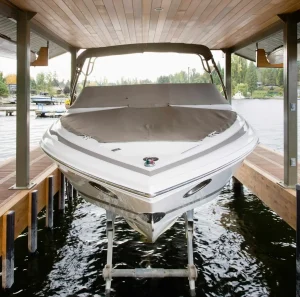
A single, appropriately-sized lift for a personal boat, installed off an existing or compliant dock, is the typical exempt scenario for the properties we work on across all four lakes.
What Can Push a Project Into Permit Territory
A few patterns tend to move a boat lift project out of exempt status:
- Multiple lifts on a single property beyond what’s reasonable for the boats actually kept there
- Oversized lifts or canopies that extend well beyond the footprint of a typical residential installation
- Combining a lift with other structures — extended platforms, large canopies, or additions that together add up to more waterway coverage than the exempt threshold allows
- Commercial or rental use of the lift, which isn’t covered under residential exemptions
- Sites with existing violations on the dock or shoreline, where adding a lift compounds an already non-compliant setup
None of these are automatic disqualifiers on their own, but they’re the situations where it’s worth confirming your specific plan with the DNR or an experienced local installer before committing to equipment.
Local Rules Can Be Stricter Than State Rules
DNR exemptions set a statewide floor, but individual municipalities, counties, and some lake associations can layer on additional requirements — setback distances, size caps, or approval processes specific to that shoreline. Madison’s Lake Monona shoreline, for example, sits under city shoreland zoning in addition to state rules. It’s worth checking local ordinances in addition to DNR guidance, particularly in more densely developed areas.
How This Differs From Dock/Pier Permitting
Boat lift rules and dock/pier rules are related but evaluated separately. A dock that’s fully exempt on its own can still have permit implications once a lift, canopy, or additional platform is added to it — the combined structure is what gets evaluated, not just the dock in isolation. If you’re planning both a new dock and a lift, it’s worth reviewing both sets of guidance together rather than assuming one covers the other.
What To Do If You’re Not Sure
If your project looks straightforward — one appropriately-sized lift for personal use, installed off an existing or compliant dock — you’re very likely in exempt territory and most owners on these lakes don’t need to file anything. If your plan involves multiple structures, an unusually large lift, or a property with any history of shoreline complaints, it’s worth a quick call to your regional DNR office before you install, or ask your installer to flag anything that looks like it might need a closer look.
JD Hellenbrand has installed lifts across Lake Wisconsin, Lake Monona, Lake Waubesa, and Lake Kegonsa for years and can tell you, based on your specific site, whether your plan is a straightforward exempt installation or one worth double-checking with the DNR first.
Frequently Asked Questions
Do I need a permit for a standard boat lift on my dock?
In most cases, no. A single, appropriately-sized residential lift installed for personal use typically falls under Wisconsin’s DNR exemption for waterway structures.
What makes a boat lift NOT exempt?
Common triggers include multiple lifts beyond what’s reasonable for the property, oversized structures, combining a lift with other large additions like extended platforms or canopies, and commercial or rental use.
Is the permit rule the same for docks and boat lifts?
They’re related but evaluated separately. A compliant dock doesn’t automatically mean a lift added to it is also exempt — the combined structure matters, not just the dock alone.
Do city or lake association rules matter if my lift is DNR-exempt?
Yes. Local shoreland zoning or lake association rules can be stricter than state DNR requirements, particularly in more developed areas like parts of Lake Monona. It’s worth checking both.
What happens if I install a lift that turns out to need a permit?
It can mean removal, relocation, or a retroactive permit application, all of which cost more time and money than confirming the requirement before installation. It’s much cheaper to check ahead of time.
Who can help me figure out if my project needs a permit?
Your regional DNR office can give an official answer for your specific property. An experienced local installer can also flag likely issues based on your plan before you commit to equipment — JD Hellenbrand does this as part of every estimate.
Planning a boat lift installation and want a straight answer on your specific site? Contact JD Hellenbrand or call 608-513-0690 for a free estimate.
Disclosure: This post summarizes general DNR guidance for informational purposes and isn’t a substitute for confirming requirements with the DNR or a local permitting authority for your specific property.