Key Takeaways
- A boat lift works best for changing water levels, soft or weedy bottoms, open water, and frequent use.
- A rail track system works best for boathouse storage and for guiding the boat into alignment in wind.
- Both systems can vary widely in cost because the site drives how complex the install is.
- The best choice is the system that fits your shoreline, not the one your neighbor has.
- A site review often reveals options that are not obvious from a product brochure.
This question comes up constantly around Lake Wisconsin because boathouses change everything. When you have a structure that feels like a garage for your boat, you want the boat to behave like a car. You want it centered. You want it protected. You want it easy. That is where the marine rail system conversation starts.
A boat lift and a rail track system both solve the same problem in different ways: getting the boat out of the water and into a safe, stable resting position. The best choice depends on your shoreline slope, depth at the boathouse entrance, exposure to wind, bottom conditions, and how you actually boat.
What A Boat Lift Is Really Doing
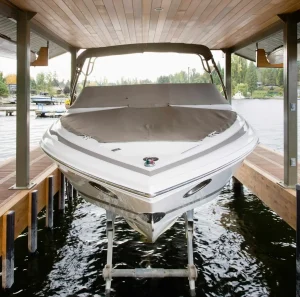
A boat lift raises your boat vertically out of the water and holds it in a consistent position. The obvious benefit is protection. Less growth on the hull. Less wave slap. Less time sitting in water that accelerates wear.
The less obvious benefit is routine. A good lift setup makes launching predictable. You guide the boat in, lift it up, and you are done. If you use your boat frequently, predictability becomes a quality of life upgrade.
Where Boat Lifts Win In Wisconsin
Changing Water Levels
Water levels move. Some seasons feel stable. Others do not. A lift can adapt more easily than many fixed path systems, especially when depth at the shoreline changes across the season.
Soft Or Weedy Bottoms
If your shoreline has muck, weeds, or uneven bottom conditions, dragging the boat is not appealing. A lift reduces bottom interaction and protects the boat and your patience.
Open Water Exposure
If your frontage takes wave action, lifting the boat out of the water can reduce constant motion. This can help protect the boat and reduce shoreline bumping and wear.
Frequent Use
If you boat often, a lift turns “launching” into a short routine instead of a project. That matters when your weekends are limited and Wisconsin summers move fast.
What A Rail Track System Is Really Doing
A rail track system guides the boat along a controlled path, often into a boathouse or toward the shoreline. Instead of lifting the boat vertically, the system moves it in a guided way that prioritizes alignment and controlled storage.
For boathouses, alignment is the headline. When the boat consistently lands in the right spot, you reduce the chaos factor. You also protect the boat from bumping and the structure from accidental contact.
Where Rail Track Systems Win
Boathouse Storage Goals
If you want the boat fully inside a boathouse, a rail system can make storage feel clean and intentional. It becomes a repeatable process, like pulling into a garage.
Alignment In Wind
Crosswinds turn docking into a sport. Rail systems reduce the guesswork by guiding the boat into position. If your boathouse entrance catches wind, alignment support can be the difference between smooth weekends and constant frustration.
Shoreline Slope Advantages
Some shorelines make vertical lift footprints awkward. Rails can work with slope in a way that fits the site, especially when the goal is protected boathouse storage rather than quick open water loading.
Cost Drivers Without Fake Precision
People ask which option is cheaper. The honest answer is that both can vary widely because site conditions drive install complexity.
A better question is: which system reduces problems on your shoreline.
Problems are expensive. A system that fights your site will cost you in maintenance, adjustments, repairs, and lost time. A system that fits your site will feel boring and reliable. That is the best value you can buy.
Maintenance Differences That Actually Matter
A lift asks you to pay attention to cables, pulleys, motors, fasteners, and general alignment. A rail system asks you to pay attention to track alignment, rollers, debris management, and the condition of the path.
Neither is maintenance free. Both are manageable if you plan for them. The deciding factor is what kind of maintenance fits your habits. If you like simple checks and predictable service intervals, you can succeed with either. If you know you will ignore small issues until they become big ones, you should pick the system that has fewer risk points for your specific site.
A Human Way To Choose
Ask yourself these questions and answer honestly.
- Do I have a boathouse, and do I want the boat fully inside it each time?
- Do I deal with crosswinds or a narrow entrance that makes alignment stressful?
- Does my water depth at the entrance change enough to cause seasonal frustration?
- Is my bottom soft, weedy, or uneven in a way that complicates guided paths?
- Do I use my boat frequently and value the fastest routine possible?
- Do I care most about speed, or about alignment and protected storage?
If you want protected boathouse storage and reliable alignment, rails often rise to the top. If you want fast routine launching and flexibility with changing depth, lifts often rise to the top.
What About Hybrid Approaches?
Some properties benefit from a blended solution, depending on layout and how the boathouse is used. The practical point is that a site review can reveal options that are not obvious from a product brochure.
The Mistake People Make
People often buy based on what a neighbor has. That can work, but it can also backfire. Two shorelines on the same lake can behave very differently. One property can be deep and stable. Another can be shallow, weedy, and wind exposed. The best system is not the popular system. It is the system that fits your site.
The Real Goal
The real goal is not owning a lift or owning rails. The goal is boating more with less friction. If your system turns every launch into a negotiation, you will boat less. If your system feels easy, you will boat more. That is the best result.
FAQs
Q: Is a boat lift or a rail system better for a Lake Wisconsin boathouse?
A: It depends on your goal. A rail system is often best when you want the boat stored inside a boathouse with consistent alignment. A lift is often best for fast launching and handling changing water depth.
Q: Which is cheaper, a boat lift or a rail system?
A: Both vary widely because site conditions drive the cost. A better question is which system reduces problems on your shoreline, since a system that fights your site costs more over time.
Q: Does a rail system help in windy conditions?
A: Yes. Rail systems guide the boat into position, which reduces the guesswork when crosswinds or a narrow boathouse entrance make docking stressful.
Q: When does a boat lift make more sense than rails?
A: When your water depth changes through the season, your bottom is soft or weedy, your frontage takes wave action, or you launch often and want the fastest routine.
Q: Can I combine a lift and a rail system?
A: Some properties benefit from a blended setup depending on layout and how the boathouse is used. A site review can show whether that fits your property.