Dock & Boat Lift Installation on Lake Monona
JD Hellenbrand installs, removes, and services docks and boat lifts on Lake Monona. We serve Madison, Monona, and all Lake Monona shoreline communities including the Maple Bluff, Lakewood, and South Madison waterfronts.
Lake Monona is one of Madison’s most prominent lakes, bordered by the state capitol on its northwest shore and residential neighborhoods around the rest of its perimeter. It’s a busy lake with significant boat traffic, which means dock placement, setback compliance, and structural integrity all matter more than on smaller, quieter lakes.
Call 608-513-0690 to schedule your Lake Monona installation.
Lake Monona Dock & Lift Services
Spring dock and pier installation. Aluminum, steel pipe, and floating dock systems.
Boat lift installation. All types including hydraulic, vertical, cantilever, PWC, and pontoon lifts.
Boat lift repair and annual inspection. Cable replacement, bunk service, drive unit repair.
Dock extension and reconfiguration. Adding sections, side arms, or T-shapes.
Barge crane service. Particularly relevant for Lake Monona’s denser shoreline neighborhoods with restricted land access.
What We Know About Lake Monona
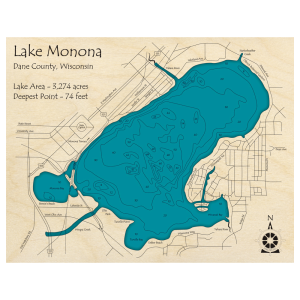
Lake Monona covers 3,359 acres in Dane County with a maximum depth of 74 feet, an average depth of 27 feet, and 13 miles of shoreline. About 40% of the shoreline is publicly owned, including stretches at Olbrich Park, Olin Park, B.B. Clarke Beach, and Esther Beach. The remaining 60% is residential, much of it in dense Madison and Monona neighborhoods.
Lake Monona is the second lake in the Yahara River chain, fed by water flowing south from Lake Mendota through the Yahara River and Tenney Locks. It exits south to Lake Waubesa via the Yahara River. Water levels are managed jointly with Lake Mendota and require maintaining a 4.9-foot difference between the two lakes per Dane County and DNR specifications.
For dock installation, Lake Monona’s mix of bottom conditions matters. Some areas have gradual sand and gravel bottoms suitable for traditional pipe docks. Others have rocky or muck bottoms that require different anchoring approaches. The deeper basin in the lake’s center means that shoreline depth varies significantly across the lake’s perimeter. We assess every property individually before recommending a dock system.
Dense Shoreline Access and Why Barge Service Matters Here
Many Lake Monona waterfront properties sit in dense residential neighborhoods. Narrow lots, tight side yards, mature trees, retaining walls, and steep land-side grades are common, which can make standard equipment-based dock installation impractical or impossible.
JD Hellenbrand’s barge crane capability is particularly relevant on Lake Monona. We can approach from the water side and complete the installation without requiring land-based equipment access. If you’ve been told your Lake Monona property is too difficult for standard installation, contact us. This is exactly the situation barge service is designed to solve.
City of Madison and Lake Monona Shoreland Zoning
Lake Monona waterfront properties within Madison city limits are subject to City of Madison shoreland zoning regulations, which govern dock length, side-yard setbacks from property lines, structure size, and certain materials and configurations. Properties in the City of Monona follow that municipality’s shoreland ordinance, which has its own rules. We flag any applicable city or municipal requirements for your specific property during the consultation, and we’ll coordinate with your municipal zoning office if a permit is needed.
Spring Installation Timing on Lake Monona
Lake Monona is a deep lake (one of only two “deep” lakes in the Yahara chain by Wisconsin DNR criteria, along with Lake Mendota) and freezes later than smaller, shallower lakes. In the 2025-2026 winter, Lake Monona officially froze December 12, 2025. Spring ice-out typically falls in late March or early April. We watch ice conditions closely and begin installations as soon as the lake is workable.
Spring installation slots fill up fast. Contact us in February or March to secure your spot. Earlier bookings get the earliest install dates.
As an Authorized Hewitt and Endres Dealer
JD Hellenbrand is an authorized dealer for Hewitt and Endres dock and lift systems. When you purchase equipment through us, you get manufacturer warranty support, access to genuine replacement parts, and a team that knows exactly how the system is designed to be installed. We also work with Clearwater Piers and Wave Armor floating dock systems, which fit certain Lake Monona shoreline conditions better than fixed pipe docks.
Schedule Lake Monona Dock Installation
Phone: 608-513-0690
Address: N1792 Ryan Road, Lodi, WI 53555
Website: jdhellenbrand.com
Frequently Asked Questions: Lake Monona Dock Installation
Does JD Hellenbrand serve Lake Monona properties in Madison and the City of Monona?
Yes. We serve the full Lake Monona shoreline including Madison, the City of Monona, Maple Bluff, and surrounding communities. Lake Monona is within our standard service area and we work the lake throughout the spring and fall seasons.
My Lake Monona property has limited access from the land side. Can you still install a dock?
Yes. This is exactly the situation our barge crane service is designed to solve. We approach from the water side and complete the installation without requiring land-based equipment access. Lake Monona’s dense residential shoreline makes this scenario common, and we handle it routinely.
What dock style is best for Lake Monona?
It depends on your water depth, shoreline type, and how you use the dock. Lake Monona properties vary significantly. Some have gradual sand or gravel bottoms suitable for pipe docks. Others have rocky or muck bottoms that require floating systems or specialized anchoring. We assess each property individually.
When does Lake Monona freeze and clear of ice?
Lake Monona typically freezes in mid to late December and clears in late March or early April. The 2025-2026 winter freeze date was December 12, 2025. Smaller lakes in the area freeze earlier; Lake Mendota tends to freeze later because it’s larger and more wind-exposed. Spring ice-out timing varies year to year, and we adjust the installation schedule accordingly.
How deep is Lake Monona, and does that affect my dock?
Lake Monona has a maximum depth of 74 feet, with an average depth of 27 feet. The deep basin doesn’t affect most dock installations because shoreline depth is what matters for dock design. Most Lake Monona docks reach 6 to 12 feet of water at the end of the dock. We measure your specific shoreline depth during the consultation.
Do I need a City of Madison permit for my Lake Monona dock?
It depends on the dock configuration and your specific property. The City of Madison has shoreland zoning regulations that govern dock length, setbacks, and structure size. Most standard residential dock configurations comply without a permit, but larger structures, multi-slip configurations, or platform additions may require one. We flag any applicable requirements during the consultation and coordinate with your municipal zoning office if needed.
Can JD Hellenbrand also handle my Lake Monona boat lift?
Yes. We install, repair, and service all types of boat lifts on Lake Monona. Hydraulic lifts, vertical lifts, cantilever lifts, PWC lifts, and pontoon lifts are all part of our standard service. Annual inspection during fall removal helps catch issues before they become spring problems.
How do you handle the busy Lake Monona boat traffic during installation?
We schedule installations early in the day and during weekday windows where possible to minimize coordination with active boat traffic. We’re familiar with the lake’s high-traffic areas and plan accordingly. Most installations don’t significantly affect lake usage.