Key Takeaways
- Sectional docks are fixed-height, post- or leg-supported, and best suited to shorelines with stable, predictable water depth.
- Floating docks ride up and down with the water level, making them the better choice for shorelines with fluctuating levels or soft, uneven bottoms.
- Sectional docks generally cost less per foot and are simpler to maintain long-term; floating docks cost more but handle water-level swings that would strand a fixed dock.
- Bottom conditions matter as much as water-level stability — soft or mucky bottoms often favor floating systems regardless of how stable the lake level is.
- Both styles need seasonal removal in Wisconsin’s climate; floating docks are generally easier and faster to pull for winter.
- Lake Wisconsin’s dam-controlled level changes and Lake Monona’s denser, more variable shoreline are two examples where the “right” choice differs from lake to lake — there’s no single best answer across all four lakes we serve.
If you’re choosing between a floating dock and a sectional (fixed) dock for a property on Lake Wisconsin, Lake Monona, Lake Waubesa, or Lake Kegonsa, the honest answer is that both are good systems — the right one depends on your specific shoreline, not a general rule of thumb.
How Sectional Docks Work
Sectional docks sit on legs or posts driven into the lakebed, holding the deck at a fixed height above the water. They’re built from modular sections that bolt together, which makes them easy to reconfigure — add an L-shape, extend the length, or adjust the layout from year to year.
Best for:
- Shorelines with stable, predictable water depth
- Owners who want a rock-solid, non-moving surface (easier for kids, pets, and mobility-limited users)
- Firmer lake bottoms that hold a post securely
Tradeoffs:
- A fixed-height dock can end up too high or too low if water levels shift significantly during the season
- Installation requires the bottom to support driven posts or footings, which isn’t possible on every site
How Floating Docks Work
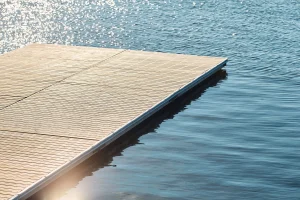
Floating docks sit on flotation units (foam-filled or air-filled drums, or modern polyethylene tanks) and rise and fall with the water level, connected to shore by a hinged ramp or gangway.
Best for:
- Shorelines with water levels that change meaningfully over the season — this is a real factor on Lake Wisconsin, where levels are managed by the Prairie du Sac Dam and can shift with releases
- Soft, mucky, or uneven bottoms where driving posts isn’t practical or wouldn’t hold securely
- Deeper water where a sectional dock’s legs would need to be unreasonably long
Tradeoffs:
- Generally costs more per linear foot than a comparable sectional dock
- The connection point (ramp/gangway) needs regular inspection and adjustment
- Some floating systems feel less stable underfoot than a fixed dock, which matters for some households
Cost Comparison
Sectional docks are typically the lower-cost option upfront, largely because the structure and installation are simpler. Floating docks cost more due to the flotation components and more involved anchoring/mooring setup, but that added cost buys you resilience against water-level changes that could otherwise strand a fixed dock in shallow water or leave it submerged.
For an apples-to-apples comparison specific to your shoreline and budget, our docks and piers page breaks down the dock types we install, or you can get a free estimate for both options side by side.
Bottom Conditions Matter as Much as Water Level
Water-level stability gets most of the attention in this decision, but lakebed composition is just as important. A firm sand or gravel bottom can support a sectional dock even in areas with some seasonal fluctuation. A soft, silty bottom — common in parts of Lake Waubesa and Lake Kegonsa — often pushes the decision toward a floating system even if the water level itself is relatively stable, simply because posts don’t hold reliably.
Maintenance and Winter Removal
Both dock types need to come out for winter in Wisconsin — see our dock storage guide for what that process looks like and why it matters for the life of your equipment. Floating docks are generally faster to remove since there’s no need to pull posts, but the flotation units themselves should be inspected annually for cracks or water intrusion. Sectional docks need their hardware (bolts, brackets, leg connections) checked for corrosion each season.
Which One Do We Recommend?
We don’t have a default answer — it genuinely depends on your site. On a visit, we’ll look at your water depth across the season, bottom composition, and how you use the dock, then recommend whichever system actually fits. If you’re not sure which lake-specific factors apply to your property, our lake pages have more detail: Lake Wisconsin, Lake Monona, Lake Waubesa, and Lake Kegonsa.
Frequently Asked Questions
Which is cheaper, a floating dock or a sectional dock?
Sectional docks are generally less expensive per linear foot because the structure and installation are simpler. Floating docks cost more due to the flotation and anchoring components, but that cost buys protection against water-level changes.
Can I switch from a sectional dock to a floating dock later?
In many cases, yes, though it usually isn’t a simple retrofit — it typically means a new installation rather than modifying the existing structure. It’s worth discussing with an installer before committing to either system if you expect your needs to change.
Do floating docks work in shallow water?
Yes, floating docks often work better than sectional docks in shallow or variable-depth water, since they ride with the water level instead of needing legs sized for the deepest point.
Which is more stable to walk on?
Sectional docks are generally more rigid and stable underfoot since they don’t move with wave action or wakes. Floating docks have some give, though quality varies significantly by manufacturer and anchoring setup.
Do both dock types need to be removed for winter in Wisconsin?
Yes. Ice movement can damage either type if left in over winter. Floating docks are typically faster to pull since there are no posts to remove.
Which type of dock is best for Lake Wisconsin specifically?
It depends on where on the lake you’re located and how the dam-controlled water level affects your specific shoreline. Many Lake Wisconsin properties do well with floating systems because of level fluctuation, but firmer-bottom sites can work well with sectional docks too.
Not sure which dock fits your shoreline? Get a free estimate or call 608-513-0690 — we’ll walk your site and give you a straight answer.